Cross Hole Sonic Logging (CSL)

Ensure the integrity of your critical structures with Cross-Hole Sonic Logging (CSL). Our advanced testing delivers unmatched accuracy, detects damage, and verifies repairs to safeguard your project’s success.

Trusted by Industry Leaders

Get in Touch

CSL Services

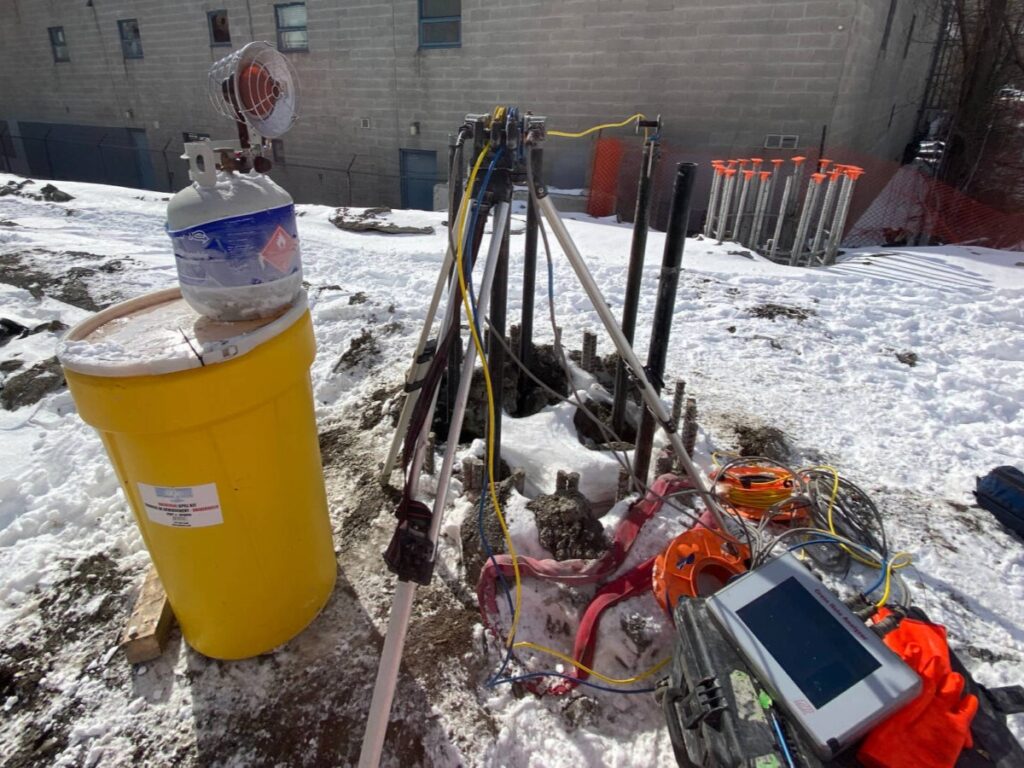
SACL uses the CHAMP-Q CSL system by Pile Dynamics to perform Crosshole Sonic Logging (CSL) and Tomographic Imaging (CSLT)—advanced methods for evaluating the internal quality of drilled shafts, caissons, slurry walls, and other concrete elements. These non-destructive tests are conducted in accordance with ASTM D6760-16.

How it works

CSL measures the time it takes ultrasonic signals to travel between probe pairs inside access tubes cast into the shaft. Slower travel times and lower signal amplitudes can indicate voids, inclusions, or poor concrete. CSLT enhances this by producing 2D or 3D velocity maps of the structure using multiple signal paths.

Key Advantages

  • Detects flaws, voids, and inclusions with high accuracy
  • Portable and non-destructive—no interruption to site work
  • Effective at any depth without loss of precision
  • Supports verification of post-repair integrity


From bridges to high-rise foundations, CSL and CSLT offer deep visibility into structural integrity —ensuring quality from the inside out.

Our CSL Projects

Our Services

Consulting

Get the geotechnical insights you need to ensure the safety, stability, and success of your construction project.

Non-Destructive Testing

Ensure your projects meet the highest standards of quality and safety with minimal disruption.

Equipment Rental

We offer top-quality equipment rental and calibration services tailored to the geotechnical engineering industry.

Other Services

We deliver various specialized engineering services for remote monitoring, erosion testing, and quality verification.

Frequently Asked Questions

Yes, Pulse Echo Testing (PIT) can be used to verify anomalies detected by Crosshole Sonic Logging (CSL) testing. While CSL provides a detailed assessment of the integrity of drilled shafts and other deep foundations by evaluating the sound wave travel times between pairs of access tubes, PIT offers a complementary method by sending a stress wave down the length of the shaft and analyzing the reflected signals. This can help confirm the presence, location, and extent of anomalies such as voids, inclusions, or cracks identified during CSL testing, providing a more comprehensive evaluation of the foundation’s condition. It is important to note, however, that anomalies at the pile toe are difficult to detect using PIT as they can be masked by the toe reflection.


Thermal Integrity Profiling (TIP) and Cross-Hole Sonic Logging (CSL) are both methods used to evaluate the integrity of deep foundations, but they operate differently:

  • TIP: Uses the heat generated by curing concrete to detect anomalies. Sensors measure temperature variations along the pile, identifying potential defects like voids or inclusions based on deviations from expected temperature profiles. This test also allows to assess the concrete cover by detecting deviations of the reinforcing cage.
  • CSL: Involves passing ultrasonic pulses between pairs of access tubes installed in the pile. By analyzing the travel time and signal strength of these pulses, CSL can detect anomalies within the pile core defined by the positioning of the access pipes within the cage. This test does not report on concrete outside the core.

Affiliations & Certifications

Reach Out For Expert
Testing and Reliable Service

Hours:

Contact Us

Access Your Data

You are about to access data that is maintained on a site external to SACL systems. 

Please note that SACL is not responsible for the content, privacy policies, or practices of external sites. By proceeding, you acknowledge that the external site may have different cookie settings and data handling policies.