SACL has highly trained engineers with ‘Expert Certification’ on the Dynamic Measurement & Analysis Proficiency Test by the Pile Driving Contractors Association and Pile Dynamics Inc.


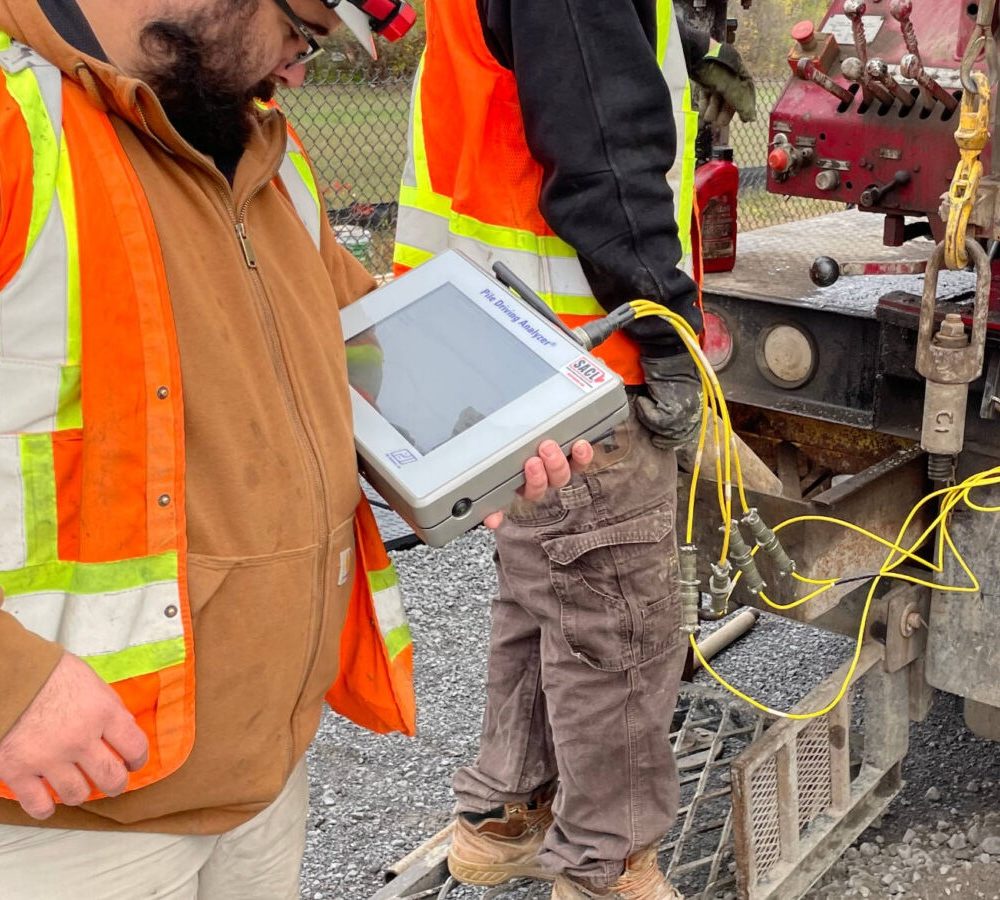
SACL offers Dynamic Load Testing using the Pile Driving Analyzer® (PDA) system—an efficient, cost-effective method to assess pile capacity, driving stresses, and shaft integrity during installation or restrike. This high-strain test is performed in accordance with ASTM D4945-17 and is ideal when static testing is impractical, too costly, or time-consuming. PDA testing uses sensors attached to the pile to measure strain and acceleration, analyzing wave propagation to evaluate:
• Bearing capacity during driving or restrike
• Hammer performance and energy transfer
• Driving stresses and risk of structural damage
• Pile shaft integrity
Why Choose SACL for PDA Testing
• Lower cost and faster setup
• Minimal site disruption
• Accurate, high-resolution results
• Fully designed and executed in-house in Canada
• Proven across Canadian and international projects since 2011
Dynamic testing helps reduce foundation risk—providing fast, reliable insights without disrupting your schedule.
Yes, dynamic testing using the Pile Driving Analyzer (PDA) can be used to test cast in place or continuous flight auger concrete piles (CFA). PDA testing measures the response of a pile to a dynamic load, providing information on pile capacity, integrity, and soil resistance distribution. This requires the PDA Engineer to be highly experienced in setting up and conducting such tests and in selecting and modeling a proper hammer to prevent inducing excessive tensile stresses that can damage the pile.
Yes, bidirectional testing can be performed on bell piles. Bidirectional static load tests (BDSLT) involve installing a load cell within the pile, which applies an upward and downward force simultaneously. This type of testing can accommodate the unique geometry of bell piles, allowing for accurate measurement of their load-bearing capacity and performance under different loading conditions. It is important to note, however, that the pile must have sufficient shaft resistance to counter the end bearing by providing reaction to the bidirectional cell. If this condition is not met, a reaction frame would be needed at the pile head to supplement the shaft resistance.

Yes, PDA testing can help determine the uplift capacity of piles. By analyzing the pile’s response to dynamic loading, PDA testing can estimate the full resistance distribution along the pile which allows the estimation of uplift resistance.
The PDCA (Pile Driving Contractors Association) certification for dynamic testing (PDA) is a professional certification that signifies proficiency in conducting and analyzing dynamic load tests using the Pile Driving Analyzer (PDA). This certification ensures that the individual has the necessary skills and knowledge to perform dynamic testing accurately and interpret the results effectively, which is critical for assessing pile capacity and integrity.
Dynamic (PDA) or static pile testing (SLT) should be performed ideally before finalizing the foundation design. This is the most effective way to confirm the design parameters and ensuring adequate foundations. Additional testing may be beneficial during the construction phase, after the piles have been installed but before the construction of the superstructure begins. This timing allows for the verification of pile capacity and integrity, ensuring that the foundation will perform as expected under the design loads.
You are about to access data that is maintained on a site external to SACL systems.
Please note that SACL is not responsible for the content, privacy policies, or practices of external sites. By proceeding, you acknowledge that the external site may have different cookie settings and data handling policies.